


AN ELEGY TO EXCESSIVE NOSTALGIA WITH REFIK SANCAR
Photographer
WORDS: MERI UTKOVSKA


There is a taking in photography. The fragmented existence of the subject photographed is transmuted into a palpable thing, a document of what has been taken - the youth on someone's face, not yet burdened by life's unforgiving passage, or spring's first blossoms hanging above ever-wondering eyes, or the unyielding grief that has taken hold, still unaware of its own transience. The photographer takes a fragment and makes a whole, giving the viewer an insight into the shared - photographer and the photographed existing in unison.
Met with these visual elegies, the viewer can choose to find what they carry in themselves, in which case the viewer's existence is altered by coming into contact with them, or give them a new meaning, in which case the union of photographer and photographed is altered by coming into contact with the viewer. In both cases, there is a transformation present, and in both cases, photography is the bridge into another's experience.
Film photographer Refik Sancar uses his camera as an "extension of himself". His practice takes him closer into the very being of people and things, allowing him to document their being in the world and of the world as an ordinary, natural happening. In our conversation, he speaks about the "excessive nostalgia" that lives in his photographs and is a doorway into joy, his process of working with black-and-white photography and cyanotypes as they challenge conventional norms, and how slowing down inspires him to see more.
ABOUT THE ARTIST
Refik Sancar is a film photographer born in 1997, working primarily with black-and-white film and
cyanotype processes. His work reflects the nostalgic beauty of overlooked moments and corners in
the rapidly-changing everyday life. Through labor-intensive, tangible processes—from analog film to
cyanotype prints and animations—each frame develops an individual work that resists the one-second
consumption of digital image culture. By slowing down both creation and viewing, Refik invites
audiences to re-experience the emotional resonance between humans and photographic images.
He is currently living and studying for his Ph.D. in Frankfurt, Germany, where he obtained his M.A. in
American Studies focusing on modernist photography in the U.S.
A selection of his cyanotypes is currently on view in a group exhibition at Nälkälinnanmäki Culture House, Finland, until January 2026.
A RAY OF SIGH is honoured to present a selection of photographer Refik Sancar's works, as well as a conversation with the artist encompassing his inspiration, process, and perspective.
SELECTED WORKS
the afternoon light on the table
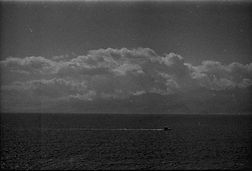
clouded peaks, loner boat
still coffee
knotted curtain
sunlight on my shoulder
hometown marketplace, cyanotype
picnic with a mediterranean view
figuring out the shutter cable
sun-kissed dishwasher
manhole in fall
hunger and solitude, cyanotype on papyrus

the afternoon light on the table
© Refik Sancar
MERI UTKOVSKA Refik, thank you so much for being a part of this conversation. It took us a while to get here, but I’m happy we finally made it.
REFIK SANCAR Thank you for giving me this opportunity, Meri. I guess we were both suffering from the usual flow of life, but I am also happy that we were finally able to have this meeting.
MERI UTKOVSKA How are you doing?
REFIK SANCAR I'm doing well, thank you. Recently, I haven't taken as many photographs because I've had more bureaucratic tasks on my plate. It did not feel like "me," but I'm slowly getting back to it.
MERI UTKOVSKA We’re getting closer to the end of another year. It’s a joyous time for some, melancholic for others. For many, it is a time of sorrow. What’s your perspective on “an ending”?
REFIK SANCAR To be honest, I think I derive joy from melancholy and nostalgia, and it's my usual state of mind regardless of the season. Therefore, at the end of the year, the only change for me is to get used to writing the dates correctly according to the upcoming year. :) In general, "an ending" is somewhat related to a loss, in my opinion. However, changing the calendar does not necessarily mean experiencing a loss.

clouded peaks, loner boat
© Refik Sancar
MERI UTKOVSKA Photography can be seen as a practice in which human beings try to defy the notion of an ending. A photograph is, after all, a documented proof of some present moment, stretched between what has been, what is, and what is still yet to be. It’s a memory, a feeling, a smell from someone’s childhood, a story. What’s the practice of photography to you?
REFIK SANCAR The wide range of uses for photography in today’s media makes it a versatile tool for any kind of expression. However, to be specific, I understand artistic photography as work that delivers resonance to an audience without needing verbal explanation.

still coffee
© Refik Sancar

knotted curtain
© Refik Sancar
MERI UTKOVSKA I believe that practicing any art form brings us a step closer to understanding ourselves. The subjects we choose to observe, what they invoke in us as we relate to them, and how we present them to others, all are infused with who we really are. Art is a statement, is it not? And if so, what are you trying to say?
REFIK SANCAR I definitely agree with your definition of art! My understanding of art and how I express myself through my camera is constantly evolving. Currently, my work shows that simple moments in fast-paced daily life are worth looking at twice. By practicing film photography and alternative slow printing processes, such as cyanotypes, I emphasize the importance of slowing down. Years ago, during a lecture on the imagist movement in American poetry, a professor of mine defined imagism as the "plainness of the moment." Then he took out his phone and showed some of my published works as an example of this definition. I was both flattered and enlightened by his words, since I often struggle to articulate my work in a sensible way.

sunlight on my shoulder
© Refik Sancar
MERI UTKOVSKA Most of your photographs are in black-and-white, and so are mine. I had a conversation with someone once about the use of colour, or rather, the lack of it in photography, and I was told that black-and-white photography can be seen as “frightful”. Of course, I did not agree. If anything, I see it as more raw, more direct, more focused on what the actuality of the artist’s statement is.
Why do you think you choose to express yourself through black-and-white photography?
REFIK SANCAR After a couple of years of sending my films to labs when I started film photography, I ordered the equipment and began developing black-and-white film at home during the pandemic. This shift taught me about the infinite creative possibilities of monochrome photography. Working in black-and-white allows me to leave more to the imagination and resonance of the audience, since I believe the absence of color invites deeper interpretation. Also, the experimental joy of shooting and developing my own film makes the process as meaningful as the final image.
MERI UTKOVSKA You mentioned that you also work with cyanotypes. A selection of those works, in fact, is currently on view in a group exhibition at Nälkälinnanmäki Culture House, Finland, until January 2026.
How is working with cyanotypes different from working with black-and-white photography in your case?

hometown marketplace, cyanotype
© Refik Sancar
REFIK SANCAR In my photographic practice, black-and-white film photography goes hand in hand with experimental printing processes, such as cyanotypes. They both challenge conventional notions of control and perfection by being unpredictable in each session, as well as embracing natural mistakes during the process. These mistakes create imperfect results, marking each organic step involved in creating an image.
MERI UTKOVSKA It's a way of paying homage to imperfection and letting go of control, and concurrently, an invitation for the viewer to contemplate about their relationship with those notions. This can be, for some, a very violent experince - as we are creatures who seek to control. But that is art's purpose, is it not? To challenge views and notions, and bring in opportunity for growth and insights. Nonetheless, there is a sense of melancholy and longing in your work. There’s a sense of something fleeting, also: a girl with her back turned to the observer walks along an unknown shore, grounded birds resting beside her feet; a coffee cup, her shadow reflected upon a wooden table, silenced by the absence of the one for whom it was meant; a man, his form shaded by the tree’s body, overlooks a waving sea. What’s there to long for, Refik, and do you think longing is inevitable for human beings?
REFIK SANCAR I love and appreciate your depiction of my work. I see melancholy and longing as things that nourish me, and I briefly describe how this is reflected in my photography as “excessive nostalgia.” I can say that the photographs you describe, and many others, convey this nostalgia I experience in my daily life to viewers through my camera, which focuses on the “absence” within them. To answer your question, since I know my photos may not evoke similar feelings in everyone, I can only speak for myself: as long as nostalgia and longing don't prevent me from looking ahead, they will always retain their meaning and continue to exist.
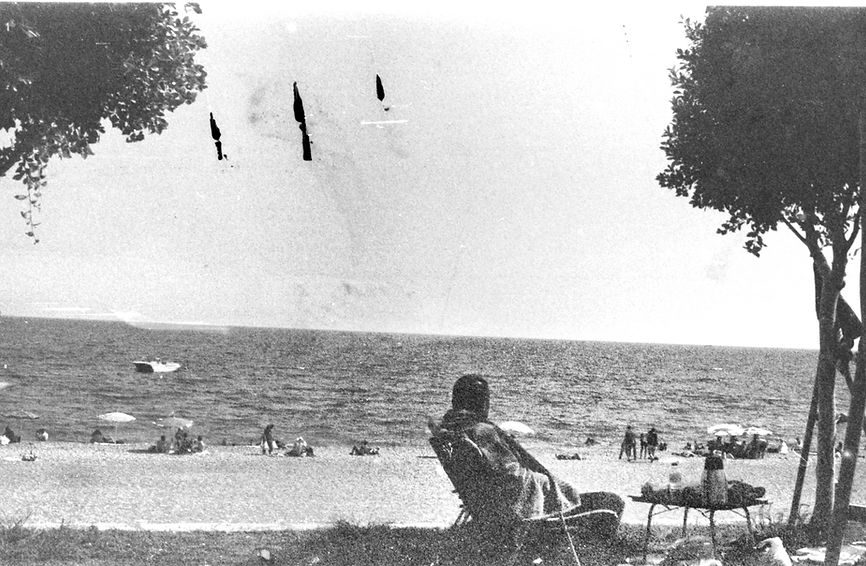
picnic with a mediterranean view
© Refik Sancar
MERI UTKOVSKA We often long for the unknown, I think, though we fear it. And it is here where the practice of photography, and the practice of any art, for that matter, becomes a tool for understanding. Allowing us to uncover the hidden, the forsaken, the vulnerable, that which is hard to admit, it opens us up to experience more: more of ourselves, more of others, more of the world. How has photography changed you, or made you more aware of who you are?
REFIK SANCAR You beautifully described the paradox of humanity's infinite curiosity about the unknown. I agree that photography, like other art forms, sheds light on more experiences, but sometimes there are photographs or artworks from other disciplines that I cannot understand, or do not attempt to understand, yet deeply affect me. The camera has become, so to speak, an extension of myself for quite some time now. This has made me, who already daydreams a lot, a slower, more detail-oriented observer of daily life. I can say that the current Refik is quite happy with this slowness.

figuring out the shutter cable, a self portrait
© Refik Sancar
MERI UTKOVSKA “Photography is an elegiac art,” said Susan Sontag in her 1977 book On Photography, “a twilight art. Most subjects photographed are, just by virtue of being photographed, touched with pathos. An ugly or grotesque subject may be moving because it has been dignified by the attention of the photographer. A beautiful subject can be the object of rueful feelings, because it has aged or decayed or no longer exists. All photographs are memento mori. To take a photograph is to participate in another person's (or thing's) mortality, vulnerability, mutability”.
To what extent do you allow yourself to participate in these things, and do you use your camera as a tool that separates you from others or as a bridge to become closer to them?
REFIK SANCAR I am grateful that you included Susan Sontag's canonical work in this conversation. It is a book I never tire of reading and keep by my side whenever I need to refresh my thoughts and feelings about photography. The part you quoted is from one of the pages where I drew the clearest lines. I can express my complete agreement with this through my photographs. For example, one afternoon, I went to the kitchen to make coffee and then ran back to the room to grab my camera to photograph a bowl in the dishwasher illuminated by the afternoon sun or the light-and-shadow play created by the same light on a kitchen towel. With the belief that total isolation is impossible, I also believe that everything participates in a universal consciousness and that the camera can be an important tool for expressing this interconnection.

sun-kissed dishwasher
© Refik Sancar
MERI UTKOVSKA We’re all here to participate in each other's experience. To witness each other, to get to know, to reflect. A photograph reflects to the artist their way of being in the world. It reflects the same to those who choose to see it. Why photography, Refik? Why not painting or sculpture? Do you think it reflects better who you are and what you’re here for? Or is it something else?
REFIK SANCAR And here I would like to quote a remark by the renowned photographer Lewis Hine: “If I could tell the story in words, I wouldn't need to lug around a camera.” I do not feel burdened by carrying my cameras with me, and although I occasionally experiment with different mediums, I am passionately devoted to analog photography. As I mentioned in one of my previous statements, my camera has become an extension of myself and has definitely made me who I am today.

manhole in fall
© Refik Sancar
MERI UTKOVSKA Can you speak a bit about your process? What it involves, what leads to it, what’s woven into it? Is it a grayish morning that inspires you to pick up the camera? Is it the softness with which the wind lifts up a person’s strand of hair? Perhaps it’s the cry of children, or the song of birds?
REFIK SANCAR All of those and more. The inspiration I draw from foggy and cold days, though different from the inspiration I get from visiting a warm Mediterranean town, equally compels me to look through the viewfinder of my camera. When the eyes I open each new day are the same as the eyes I look through the viewfinder, even days when I don't bring my camera, motivate me. Sometimes I enthusiastically go out for a photo walk and return home without taking a single shot, and rather than seeing this as a failure, I view it as an activity that develops my aesthetic sense and eye, inspiring me in any case.

hunger and solitude, cyanotype on papyrus
© Refik Sancar
MERI UTKOVSKA Ultimately, it's about realizing that you're an intricate part of the world, for still, both the world and yourself are altered by your being in it, regardless of the click or the stilness of the shutter button in a given moment. There is a spilling over, moment to moment, in perpetuity, and its presence is alive in every following photograph taken.
Refik, thank you again for sharing your work and your thoughts with me. Thank you for participating in this shared experience. It has been a pleasure.
REFIK SANCAR I thank you for featuring my work and for this conversation, Meri. It was an inspiring and delightful conversation, filled with so many thoughts and feelings about photography, that made me reflect and think about my work. If I failed to express my feelings adequately while talking about photography and my own work, please forgive me. Take care of yourself.
MERI UTKOVSKA You did beautifully. Take care.


